Quick Answer
To keep a glass sunroom cool during Alberta summers, ventilate it by opening both window sashes for a cross-breeze, add exterior shade with an awning or patio cover, use interior blinds to block direct sun, and choose a thicker, higher R-value roof that slows heat gain from above.
An Alberta summer can turn a bright glass room into a greenhouse by mid-afternoon. The good news? A few smart adjustments make all the difference. At Sunspace Relaxed Living, we’ve helped homeowners across Central Alberta enjoy their year-round retreat without the August heat wave indoors. Whether your room faces west into the setting sun or south into all-day light, comfort comes down to airflow, shade, and how your roof is built. This guide walks you through the practical steps, plus the mistakes we see most often, so your space stays a welcoming spot from spring right through the long weekends of summer.
Table of Contents
- Why summer heat builds up in a glass room
- Step 1: Open both sashes to ventilate a summer sunroom
- Step 2: Add exterior shade with awnings and patio covers
- Step 3: Manage direct sun with blinds and UV control
- Step 4: Choose a roof built to reduce heat in a sunroom
- Common mistakes when trying to keep a glass sunroom cool
- FAQ
- Conclusion
Why summer heat builds up in a glass room
Glass is wonderful for light, but it also lets solar energy pour straight in and trap warmth. A single-glazed glass room heats quickly on a sunny afternoon because the sun’s rays pass through and warm every surface inside. Without a path for that hot air to escape, temperatures climb fast.
Orientation matters too. West- and south-facing rooms take the brunt of the day’s strongest sun, while the roof absorbs heat from directly overhead. Understanding where your warmth is coming from tells you exactly which fixes will help most, and in what order.
Step 1: Open both sashes to ventilate a summer sunroom
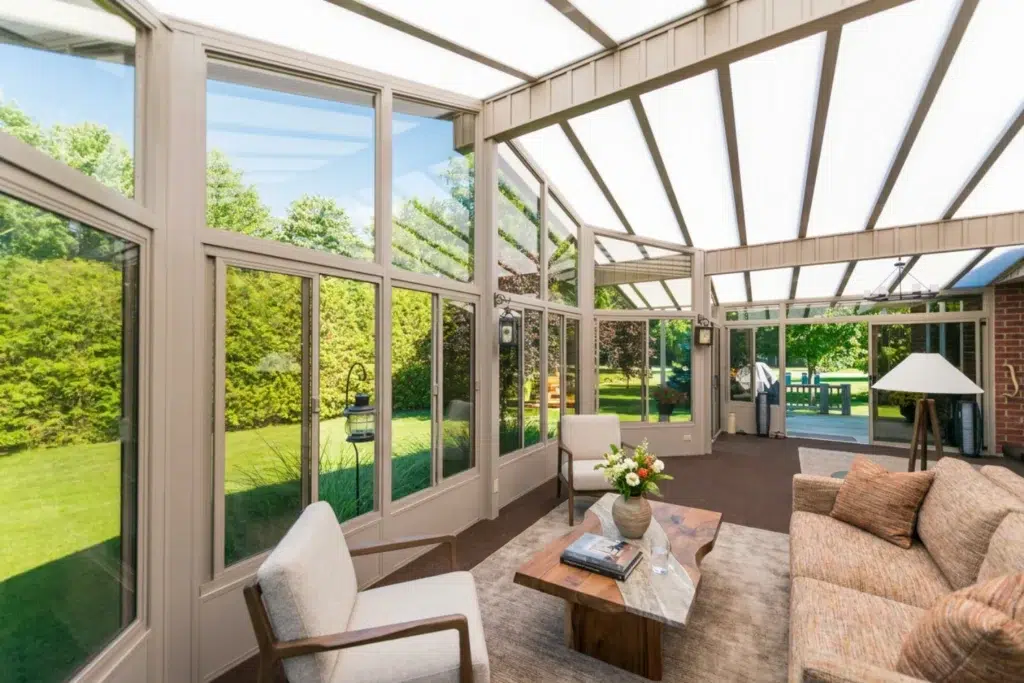
The fastest way to cool things down costs nothing: airflow. Our 3-season glass sunroom uses aluminum framed double roller windows, and both sashes operate with no fixed side. That means you get ventilation out of both sides of the room. Open windows on opposite walls and let a cross-breeze carry the hot air out.
For best results, ventilate a summer sunroom early in the morning and again in the evening, when the outside air is at its coolest. During peak afternoon heat, close the windows on the sunny side while opening the shaded side so the draft keeps moving in the right direction.
A small fan placed to pull air toward an open window multiplies the effect. Because both sashes slide, you can fine-tune exactly how much air moves through as the sun shifts across the sky.
Step 2: Add exterior shade with awnings and patio covers
Stopping the sun before it reaches the glass is far more effective than fighting the heat once it’s already inside. A retractable awning over an adjoining deck, or a patio cover that shades your walls and roof, dramatically cuts the solar load on the room.
Our acrylic patio covers are a favourite for this exact reason. They block UV and stop heat while still letting soft, natural light filter through, so you keep the bright feel without the burn. It’s shade without the cave-like darkness a solid roof can bring.
Retractable Rolltec awnings give you shade on demand. Extend them on the hottest afternoons and retract them when you’d rather welcome the sun back in. Meanwhile, that flexibility makes them a natural partner to a glass room that changes character with the weather.
Step 3: Manage direct sun with blinds and UV control
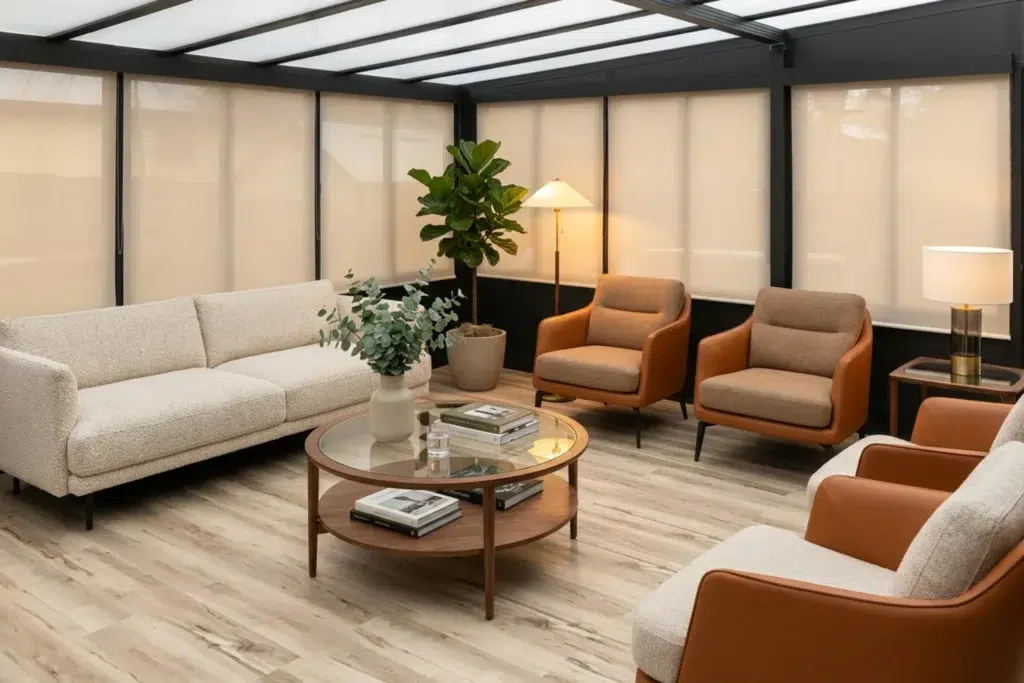
Interior blinds, shades, and solar film add a second layer of defence, especially on windows you can’t easily shade from the outside. Light-coloured or reflective treatments bounce sunlight back before it settles into the room and lingers as heat.
Position blinds to block the worst of the low-angle morning and evening sun on your east and west walls. Then adjust them through the day rather than setting them once and forgetting. It’s a small habit that keeps the space comfortable when the sun is at its most stubborn.
Solar film applied directly to the glass is another effective option, especially for large or hard-to-cover panes. A quality film cuts a significant share of incoming solar heat while staying nearly invisible, so you keep the view and the light. Placement matters, too: concentrate your film and blinds on the west- and south-facing walls that take the strongest sun, and you’ll get the biggest comfort gain for the least effort.
Step 4: Choose a roof built to reduce heat in a sunroom
The roof does a lot of the quiet work. Our sunrooms let you choose from 4″ or 6″ roof thicknesses, all constructed with a high density foam core laminated with aluminum skins on both sides. A thicker panel with a higher R-value slows heat transfer from overhead, which is one of the most reliable ways to reduce heat in a sunroom over the long term.
Roof projection, snow load, and R-value are always considered when we customize your room. As a result, the same structure that keeps you comfortable in August stands up to a Central Alberta winter. These are Canadian-made systems, climate-engineered for our cold-climate market rather than shipped in as a generic kit.
If you’d like a room that’s comfortable in every season, an insulated sunroom takes climate control even further. At Sunspace Relaxed Living, we’ll help you match the right build to how you actually plan to use the space.
Common mistakes when trying to keep a glass sunroom cool
A frequent misstep is running a fan with every window shut. Without an exit for the hot air, you’re simply stirring a trap. Always pair a fan with open windows on opposite sides so the warm air has somewhere to go.
Another mistake is relying on blinds alone and skipping exterior shade. Blinds help, but once sunlight has already passed through the glass, most of the heat is inside. Shade the glass from outside first, then let interior treatments do the finishing.
Finally, don’t overlook the roof. Homeowners often obsess over windows and forget that a thin roof pours heat down from above. Choosing the right thickness upfront saves years of discomfort and a lot of second-guessing.
FAQ
How hot does a glass sunroom get in summer?
On a clear Alberta afternoon, an unshaded single-glazed room can climb well above the outdoor temperature because glass traps solar heat. With cross-ventilation, exterior shade, and the right roof thickness, though, the space stays genuinely usable through the hottest part of the day. The exact difference depends on orientation, roof choice, and how you use the windows.
Can I add air conditioning to a 3-season glass sunroom?
Many homeowners use a portable or window-style cooling unit for short heat waves, and it works best once you’ve handled airflow and shade first. Cooling an already-ventilated, well-shaded room takes far less effort. If year-round climate control is your goal, ask us about an insulated build during your consultation.
What’s the best way to ventilate a summer sunroom?
Open both operating sashes on opposite walls to create a through-breeze, ideally in the cool morning and evening hours. Because our windows have no fixed side, you can direct airflow from whichever direction feels best. Adding a fan to push air toward an open window speeds everything up on still days.
Do acrylic patio covers really help reduce heat?
Yes. Acrylic patio covers block UV rays and stop much of the sun’s heat before it ever reaches your glass, while still letting comfortable natural light through. That combination keeps a room brighter than a solid cover would, without the sharp afternoon heat spike. It’s one of the most popular upgrades we install for shaded comfort.
Conclusion
A little airflow, some smart shade, and a well-built roof are all it takes to keep a glass sunroom cool through even the warmest Alberta afternoons. Ventilate through both sashes, shade the glass from outside, and choose the roof thickness that fits how you live.
Handled together, these steps turn a hot-box into a true relaxed living retreat you’ll actually want to sit in all summer.
At Sunspace Relaxed Living, we’ll help you design a room that stays comfortable in every season. Reach out for a free, no-obligation quote and let’s talk through your space.